

Automation Engineering
A recently introduced Siemens system that can carry out automation engineering tasks autonomously inside operational platforms is more than a feature upgrade. It signals where the industry is heading. An AI that can interpret project requirements, generate automation code, configure industrial systems, validate outcomes, and repeat the cycle until everything works is not only about moving faster. It changes what “engineering work” means in practice.
To make this real, it helps to bring it down to day to day reality. Automation engineering is not just programming a PLC or designing an HMI screen. It is translating a business need into a system that runs reliably on the plant floor. It means defining sequences, managing timing, handling exceptions, anticipating failures, and ensuring the whole setup behaves consistently even when conditions shift. It is the point where operations become a system, where physical behavior and logical control have to match with very little room for error.
Are you looking for developers?
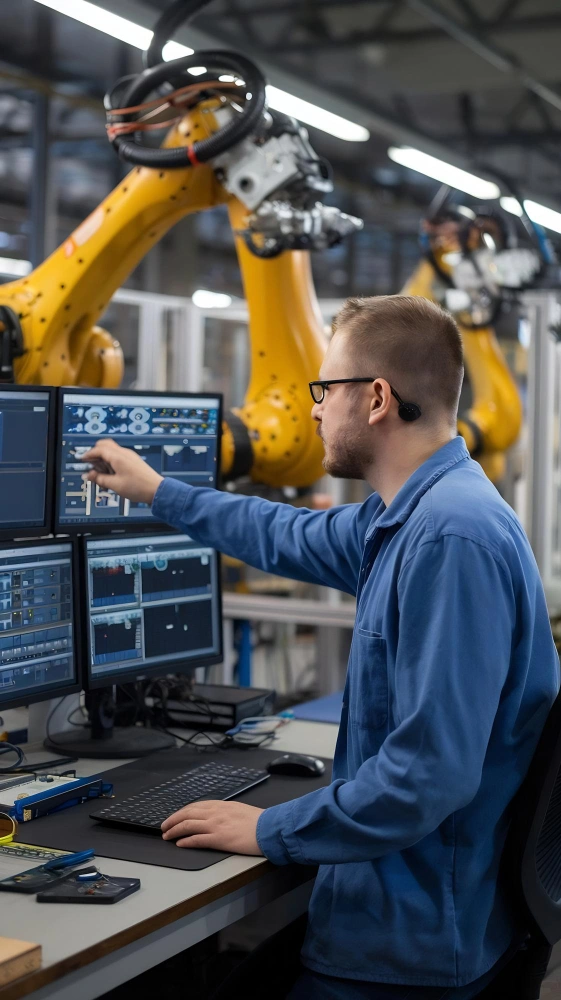
What stands out in these new approaches is that AI stops being a helper and starts taking an active role. For a long time, tools supported documentation or suggested improvements. Now we are talking about systems that execute directly inside real engineering environments. That changes the rules, because most problems do not show up in the design document. They show up when everything connects: mismatched versions, broken configurations, signals that do not behave as expected, dependencies that were never properly documented. In that context, the ability to iterate, test, correct, and try again within the same workflow becomes a serious advantage.
From an operational perspective, the impact goes beyond saving time. A large part of the cost in these projects is not writing code, it is everything that comes after: tuning, rework, late validation, and inconsistencies between systems. When workflows are more structured and validation is built in from the start, much of that friction goes away. Commissioning stops being a high risk moment and becomes one step in a more controlled process.
At the same time, this kind of capability speaks directly to a constraint many organizations already feel: the shortage of technical talent. It is not only a lack of engineers, it is a lack of people who can connect systems, data, and operations. Many companies have the technology, but not always the capacity to implement it and scale it. In that sense, these systems do not replace the engineer, but they change the engineer’s role. The work shifts away from manual execution toward supervision, decision making, and risk management.
Are you looking for developers?
Still, taking this into the real world is not as straightforward as it sounds. The challenge is not the idea, it is implementation. For a system like this to work inside a live operation, it needs organized data, it needs to integrate with what already exists, and it needs to adapt to processes that are not always documented. In many plants, information is scattered, systems do not “talk” to each other, and a lot of knowledge lives inside people’s heads. Without putting order into that foundation, automation loses its power quickly.
That is where the technical layer that often gets left out becomes critical. These systems need a solid architecture behind them: backend development to manage processes and states, APIs to connect platforms, data flows that move information reliably, and structures that ensure traceability and control. It is not only that the AI works, it is that it works inside an environment teams can trust.
There is also a point that matters in industrial settings: consistency beats speed. A system that fails in production costs far more than one that takes a bit longer to run. The real edge appears when outcomes are repeatable, when teams can trust the process, and when changes do not introduce uncertainty.
Are you looking for developers?
This is where many companies pause. They see the potential, but progress depends on solving technical problems that are not simple. Integrating systems, structuring data, building reliable connections, and keeping everything stable day after day is hard work.
Square Codex, an outsourcing company based in Costa Rica, works precisely in that layer. Through nearshore teams, it supports North American companies that need to bring these kinds of solutions into production without disrupting operations. The focus is execution: backend development, API building, system integration, and organizing data flows so these technologies actually hold up in real workflows.
On top of that, a staff augmentation model lets companies add specialized talent when they need it most, without long hiring cycles. That helps teams move faster, especially in projects where technical complexity is high and timelines matter.
AI driven automation is not a distant promise. It is already entering daily operations. The difference will not be who adopts it first, but who makes it work consistently. That is where execution stops being a detail and becomes the deciding factor.