

AI and Game Development Talent for Modern Game Studios
SEGA’s confirmation that generative AI was used during the development of Crazy Taxi: World Tour is best understood as a production signal, not a headline. Modern studios are under pressure to ship more content, maintain quality, and keep teams aligned across disciplines that move at different speeds. In that environment, generative AI is increasingly treated like a support layer inside the production pipeline, closer to the editor and build system than to marketing slogans. The practical value is not “AI made the game,” but “AI helped the team iterate faster where iteration is normally expensive.”
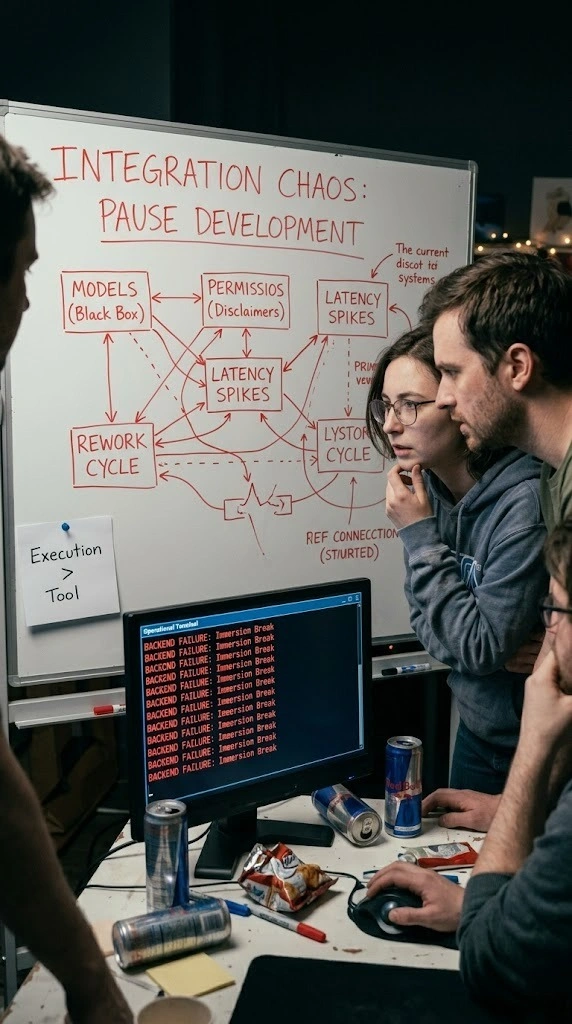
That framing matters because game development is not one workflow. It is many workflows stitched together: art and animation, design and narrative, engineering, tools, QA, localization, live operations. A studio can adopt an AI feature in one corner of the pipeline and still fail to gain real productivity if the rest of the system cannot absorb the output cleanly. This is where execution becomes the difference between a tool that saves time and a tool that creates new rework. Square Codex often supports studios at exactly that junction. As a Costa Rica based nearshore staff augmentation company, Square Codex helps North American teams add specialized game development talent and AI integration services without disrupting existing delivery rhythms

Are you looking for developers?
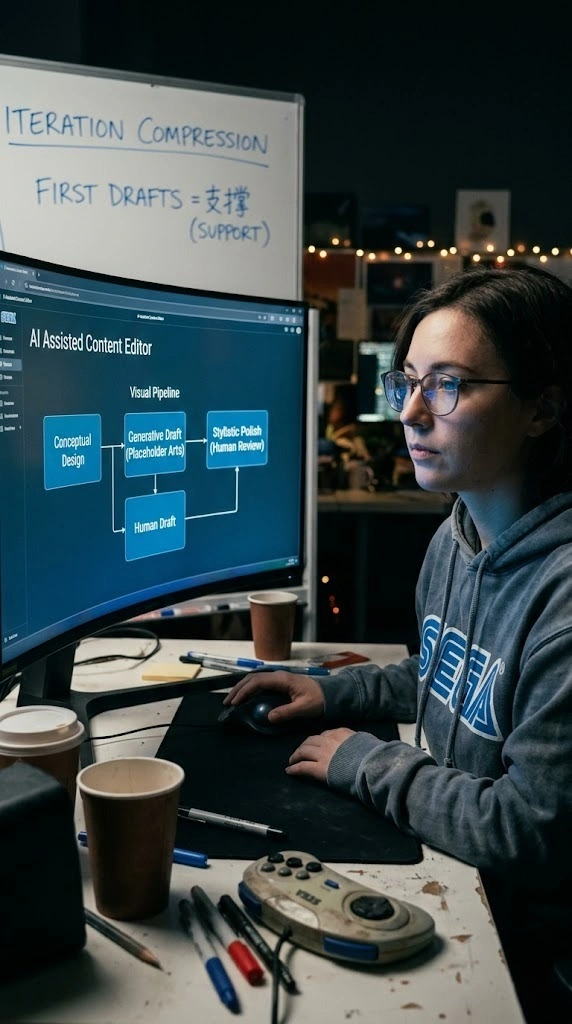
In practice, generative AI tends to earn its keep in first drafts and repetitive production tasks. Asset teams can use it for temporary props, mood variations, early UI layouts, or placeholder audio, all of which accelerate creative decision making. Designers can use it to explore variations of copy, mission prompts, or item descriptions that later go through human editing and style checks. Engineers can use it to scaffold boilerplate, accelerate internal documentation, or suggest test cases that QA and gameplay teams can adapt. None of that replaces the craft. It compresses the time between “idea” and “something you can evaluate,” which is the real currency of production.
The second place AI becomes useful is search and retrieval inside large projects. Studios accumulate massive libraries of assets, scripts, localization strings, and build artifacts. Finding the right thing at the right time is often a hidden cost. AI driven indexing, tagging, and retrieval can reduce that friction, but only if the underlying metadata is consistent and versioning is disciplined. This is where the technical foundation shows up. If a studio does not have reliable asset catalogs, clean naming conventions, and a stable pipeline for ingestion, AI assisted search becomes a noisy layer that frustrates more than it helps.
Human oversight is what keeps AI support productive. Studios that use AI in a sustained way usually formalize review paths and define what can move forward automatically versus what must be approved. Art direction, narrative tone, and gameplay balance cannot be delegated to a model. The goal is to shift humans toward validation and decision making rather than spending hours generating the first draft. That shift only works when provenance is tracked, when it is easy to roll back, and when the pipeline enforces constraints consistently. A disclaimer in a wiki does not protect a production environment. Guardrails belong in permissions, workflows, and automated checks.
Are you looking for developers?
Once AI becomes part of production, infrastructure becomes a limiting factor. A studio needs stable access to models, predictable latency, cost controls, and logs that make failures diagnosable. Some workloads run locally for responsiveness, others run in the cloud for scale, and many studios will use a hybrid approach depending on the feature. If AI is involved in content generation, moderation, or player facing interactions, backend systems need to support identity, rate limiting, caching, and safe failure modes. It is one thing to generate a concept image in a creative tool. It is another to run an AI powered NPC interaction in a live build without spiking response times or breaking immersion.
For online games, the bar is even higher. AI features can add new dependencies in live operations: real time requests, event driven processing, moderation layers, and telemetry feedback loops that are measurable. Reliability engineering becomes part of the design. Studios need observability that answers practical questions: where the latency is coming from, whether the model is failing or the integration is failing, how cost per interaction is trending, and whether changes in behavior are tied to a new build or a new data pattern. Without that, AI becomes a black box in the part of the system where black boxes are most expensive.
This is where nearshore staff augmentation is showing up as an execution strategy rather than a staffing shortcut. AI assisted game production creates demand for hybrid profiles: gameplay engineers who understand real time constraints, backend engineers who can design stable APIs, data engineers who can maintain pipelines and telemetry, and DevOps engineers who can keep cloud reliability and cost under control. Hiring those roles quickly is difficult, and waiting can freeze delivery. Square Codex supports studios by embedding nearshore engineers from Costa Rica directly into North American teams, so specialists can contribute inside the same repos, CI/CD, and daily rituals. That model makes it easier to add capacity exactly where the pipeline is bottlenecked, whether that is backend integration, AI workflow orchestration, or production tooling.
Are you looking for developers?

Square Codex is also relevant because AI integration in games is rarely a single feature. It becomes a set of services: ingestion and indexing, inference routing, content validation, moderation, telemetry, and continuous tuning. Studios need the ability to evolve those services without derailing content schedules. By providing game development talent and AI integration services through staff augmentation, Square Codex helps teams keep momentum while raising the technical maturity of the pipeline itself, which is where sustainable gains come from.
SEGA’s confirmation is a reminder that AI in game development is moving into the same category as build tooling and content pipelines: something that must be engineered, governed, and operated. The studios that benefit most will be the ones that treat AI as a production capability with measurable reliability, predictable costs, and clear ownership. AI can speed up iteration, but only disciplined integration turns that speed into shipping quality.