

Toyota’s possible investment in 400,000 robots shows how physical AI is moving from research and automation
Toyota Motor’s estimate that wider automation across its factories, group companies, and major suppliers could require around 400,000 robots and annual spending of about 1 trillion yen, or $6.4 billion, from 2028 gives physical AI a much larger industrial context. The figure should be treated carefully. Toyota has not confirmed that the full investment will proceed, and the company has not said how many years spending at that level would continue. The 400,000 robot estimate also includes replacement machines and new installations, covering humanoid and non humanoid systems across industrial robots, automated logistics, and future human robot collaboration.
Still, the scale matters. Toyota’s estimate suggests that physical AI is no longer only a research topic or a limited factory automation experiment. It is becoming part of a broader discussion about how manufacturers may connect robotics, AI models, software, data infrastructure, sensors, simulation, and production systems.
Traditional automation usually depends on predictable tasks, fixed environments, and tightly controlled processes. Physical AI is different because robots must perceive their surroundings, interpret sensor data, make decisions, interact with objects, adjust to unexpected conditions, and operate reliably in the physical world.That difference creates a much harder engineering problem. Software AI can produce text, analyze data, or generate code inside digital environments. Physical AI must also deal with friction, object position, lighting, force, motion, wear, and variation between simulated and real conditions.
Are you looking for developers?
Toyota’s work shows how this shift is taking shape. At the Kamigo Plant, a piston assembly line that began operating with robots in January 2025 moved from three operators to full automation. Toyota had introduced robots on selected sub lines as early as 2008, but later encountered maintenance challenges as automation expanded overseas.
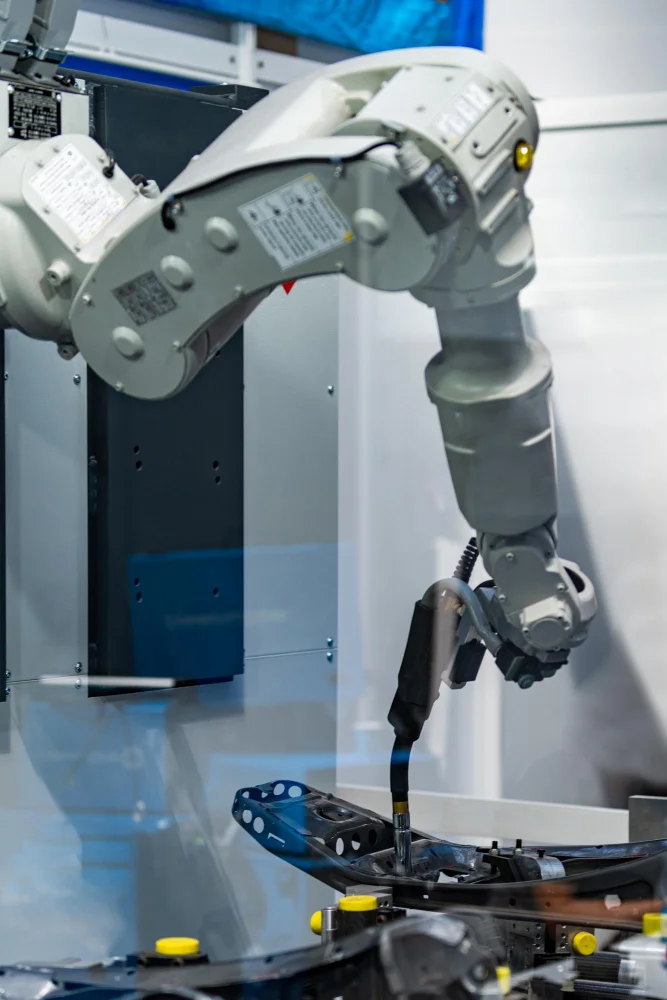
The company also developed KumiPro, a parts picking robot that uses cameras to identify loosely positioned components. The system can use force feedback control to compensate when camera recognition does not perfectly match the actual physical position of an object. Toyota is also developing ELEY, or Embodied Learning robot for Enhanced Yield, for tasks involving physical contact with objects and the surrounding environment.
These examples show that physical AI in manufacturing is not only about placing more robots on production lines. It is about creating robots that can sense, adapt, learn, and repeat tasks reliably enough for industrial use.
As robotics moves toward larger scale deployment, the robot itself becomes only one part of a much larger technical system. Large scale physical AI requires AI models, robotics control systems, sensor data, computer vision, backend systems, APIs, simulation environments, data pipelines, cloud and edge infrastructure, monitoring, security, automated testing, and DevOps.
Reliability and repeatability become critical when intelligent systems interact with machinery. A wrong output in a digital workflow can be corrected through software controls. A wrong motion in a factory setting can damage equipment, interrupt production, or create safety concerns. This is why robotics AI needs stronger engineering discipline than many experimental AI projects.
Are you looking for developers?
Toyota has identified long duration reliability, repeatability, precise positioning, and data infrastructure for robot learning as remaining challenges. That point is important because physical AI depends on continuous learning loops. Robots need data from successful and unsuccessful attempts. Engineers need to analyze that data, improve models, update control systems, test changes, and monitor behavior after deployment.
Simulation is part of that process. Toyota is using reinforcement learning in simulated environments to train humanoid robots before transferring learned behavior to physical machines. Thousands of simulated robot instances can run in parallel, but Toyota notes that behavior learned in simulation does not always transfer directly to physical robots. Sensor readings, floor friction, actuator behavior, and other real conditions can differ. This Sim2Real gap is one of the reasons physical AI requires both advanced software and practical robotics engineering.
Toyota Research Institute’s work with Boston Dynamics on AI control systems for Atlas also reflects this direction. The organizations demonstrated Atlas performing walking, lifting, sorting, and packing tasks using a Large Behavior Model, with skills added through human demonstrations. The lesson is not that humanoid robots are ready for every production environment. The lesson is that AI robotics increasingly depends on the connection between demonstrations, simulation, control software, and physical validation.
Manufacturers exploring robotics automation now need capabilities that go beyond mechanical engineering. They need AI development, backend development, API integration, data engineering, cloud infrastructure, edge computing, DevOps, QA automation, security, computer vision, and enterprise software development.
A robot on the factory floor may depend on cameras, sensors, control software, internal applications, data pipelines, dashboards, maintenance systems, and cloud or edge processing. If one layer fails, the issue may appear as a robotics problem even when the root cause is poor data, weak integration, insufficient observability, or unreliable software deployment.
Are you looking for developers?
This is why manufacturers should treat physical AI as a platform challenge. Robots must be connected to systems that can collect data, manage models, test workflows, monitor equipment, trace errors, and support safe iteration over time.
For companies evaluating physical AI, robotics software, or AI in manufacturing, the need is not only better machines. It is also stronger engineering capacity. Internal teams may already understand production environments, safety requirements, and business processes, but they may need additional software talent to build the infrastructure around robotics systems.
In this context, Square Codex can support organizations as a nearshore software development and staff augmentation partner. Square Codex does not need to be connected to Toyota, Boston Dynamics, Hyundai, or any company mentioned in this discussion to be relevant to the broader engineering challenge. The connection is practical: companies building AI powered industrial systems often need help with backend development, API integration, data engineering, cloud and edge infrastructure, DevOps, QA automation, AI development, and custom enterprise software.
Square Codex helps companies expand engineering capacity while internal teams retain ownership of products, architecture, systems, and technical decisions. That matters because physical AI depends on company specific workflows, data, infrastructure, and operational constraints.
Toyota’s estimate puts physical AI in focus, but the next stage will depend on more than better robots. It will depend on the software architecture and engineering infrastructure surrounding those machines. As robotics moves into larger industrial environments, the organizations best prepared will be those that can connect AI models, data, simulation, controls, cloud or edge systems, monitoring, and human expertise into reliable production platforms.