

AI Booking Restrictions Highlight a New Challenge for Digital Platforms
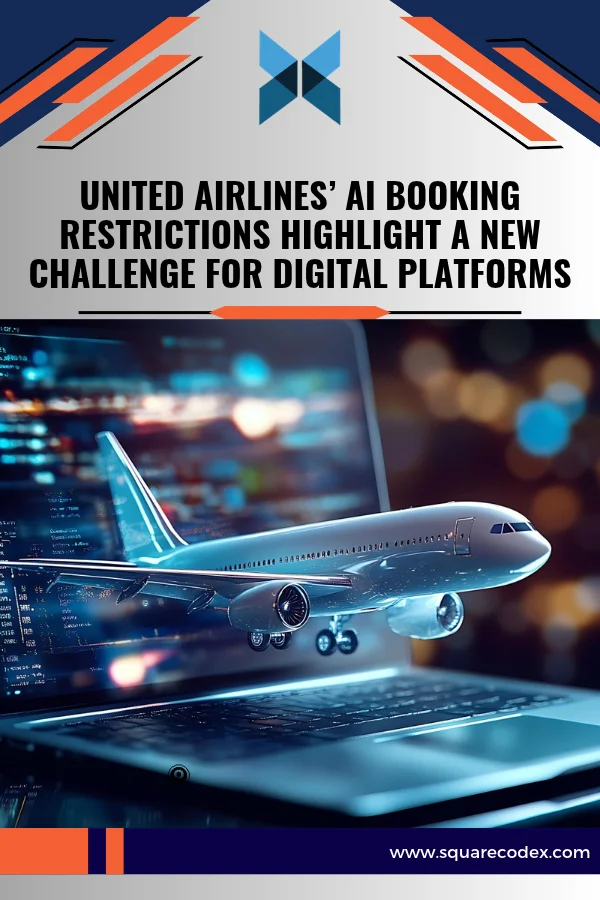
United Airlines is drawing a boundary around what third-party artificial intelligence assistants can do on its digital platforms. The carrier is restricting unauthorized AI agents from completing bookings, including when they attempt to operate indirectly through travel agencies and aggregators.
The distinction matters: an assistant may help a traveler discover a United flight, but an unauthorized system cannot purchase the ticket on that traveler’s behalf. Established aggregators such as Kayak, Hopper, and Google Flights can continue displaying United fares.
United’s decision raises a question that extends well beyond airlines. As AI agents move from answering questions to carrying out transactions, who controls their access to customer accounts, payment processes, and business systems?
United is updating its booking, ticketing, and distribution policies to reflect the restrictions. Its concerns are not limited to whether an automated tool can find the right fare.
Are you looking for engineers?

The airline warns that customers who share account credentials with third-party AI assistants could expose sensitive information. It also points to the possibility of unintended purchases, changes to accounts, and unauthorized use of MileagePlus miles.
Air travel introduces procedural obligations that a simple shopping interface may not capture. United has cited potential issues involving Federal Aviation Administration and Department of Transportation requirements. One example concerns check-in procedures requiring passengers to acknowledge that their baggage does not contain prohibited substances, including explosives.
These concerns do not establish that aviation regulations prohibit AI booking agents. They illustrate why United wants tighter control over actions that affect passengers and airline operations. The carrier also plans to update its Digital Trust Center with information about its policies and guidance on protecting accounts.
Aviation analyst Henry Harteveldt of Atmosphere Research Group has suggested that additional flight searches generated by agents may create costs for airlines. That is an analyst’s observation, not a reason United has confirmed for its decision.
JetBlue President Marty St. George has offered a different emphasis. Speaking at the Skift Commerce Summit in New York, he said airlines must respond if customers find AI-powered booking tools more convenient.
That openness comes with commercial questions. St. George also asked how AI booking services will recover their development costs and whether intermediaries might eventually charge airlines for bringing travelers to their flights. JetBlue prefers bookings on its own website, where it can present its wider product offering without additional third-party distribution costs.
Are you looking for engineers?
His remarks should not be mistaken for a policy authorizing outside agents to complete purchases. Southwest Airlines is pursuing a more defined integration. In October, it introduced a ChatGPT plugin developed with OpenAI and AWS that lets travelers discover destinations and shop for flights through ChatGPT. They then continue the booking process on Southwest’s website.
Southwest describes this as the first phase of its AI-powered booking plans, not an autonomous purchase service. Unlike an unauthorized agent attempting to transact independently, the integration establishes a deliberate route from AI-assisted search to the airline’s own booking environment.
Taken together, the three approaches emphasize different priorities. United is restricting transaction access, JetBlue is weighing customer preference against distribution economics, and Southwest is testing a partner-led path for discovery. None resolves every question about how agent-driven commerce should work.
The software challenge begins when an assistant moves beyond information retrieval. Searching flights, selecting a seat, changing account details, and submitting payment are different actions with different consequences.
For businesses designing AI-connected services, authentication must establish whose account is involved. Permission boundaries should limit what an agent can view or change. APIs need predictable rules for sensitive operations, and purchase workflows should preserve explicit customer confirmation.
Are you looking for engineers?

Systems also need to handle failed requests, duplicate submissions, and incomplete transactions. Audit records and monitoring can help teams reconstruct what an agent attempted and whether an authorized action succeeded. Human support remains necessary when identity, intent, or transaction status cannot be resolved safely.
These are general software engineering considerations, not technical controls that United, JetBlue, or Southwest has disclosed implementing.
Protecting personal and payment information becomes especially important when several platforms participate in one customer journey. Simply exposing an existing API to an AI assistant is not the same as designing a dependable transaction service.
AI-assisted commerce therefore raises architecture questions alongside commercial ones. Companies need consistent data, secure backend systems, clear ownership of customer interactions, and interfaces that can accommodate changing access policies.
For organizations developing those capabilities, Square Codex can provide additional software engineering capacity. The Costa Rica-based nearshore development and staff augmentation partner serves North American companies through custom applications, backend and API integration, data engineering, cloud development, DevOps, and QA automation. Such work can support maintainable integrations and controlled workflows without suggesting that Square Codex operates airline booking systems or guarantees regulatory compliance.
United’s restrictions highlight a broader reality for digital platforms. The central issue is no longer whether AI can find a product or service. It is whether businesses can let an agent act while preserving customer intent, protecting sensitive information, and retaining accountability for every consequential transaction.