

Enterprise AI in Production
The discussion around enterprise AI infrastructure is changing tone, and a recent interview tied to HP makes the shift easy to spot without drama. The question is no longer whether companies will “do AI.” The question is whether they can run it in production without runaway costs, without breaking critical processes, and without losing control. What used to be a side experiment now touches the core of operations: data, systems, permissions, audit trails, and accountability.
Many organizations start from an assumption that sounds reasonable but often fails in practice: “we have data, so we can automate.” The problem is that data is rarely ready to support decisions. It sits across CRM, ERP, service tools, finance systems, internal platforms, and legacy environments that still do important work but do not connect cleanly. That fragmentation limits analytics, but it also blocks something more valuable: execution. A model can recommend the next best action, but if it cannot read real time inventory, validate commercial terms, or write back changes with traceability, AI stays stuck at advice instead of outcomes.
In that setting, technical debt becomes an operational cost, not an engineering debate. Organizations accumulate one off integrations, scripts nobody wants to touch, and workflows held together by habit. When AI is layered on top of that map, the same symptoms show up: inconsistent answers, latency that ruins the experience, duplicated records, and teams that do not trust the system because they cannot explain how it reached a conclusion. The model is not the limiting factor. The environment is.
Are you looking for developers?
The other reality check shows up on the bill. Many companies find that a cloud only approach works for experimentation, but becomes hard to sustain once inference volume grows, agents multiply, and usage becomes continuous. Cost does not rise in a straight line. It rises with volume, workflow complexity, and the level of availability the business expects. Add data residency requirements, response time expectations, and dependencies on internal systems that cannot simply move into a full cloud architecture, and the constraints become very real.
That is why hybrid, and in some cases more local first, approaches are gaining ground. Not as a step backward, but as a way to balance latency, cost, and control. Some workloads belong close to where data lives or where decisions happen, while others benefit from cloud elasticity. The goal is a scalable architecture that makes clear what runs where, how data moves, and how governance holds when demand shifts.
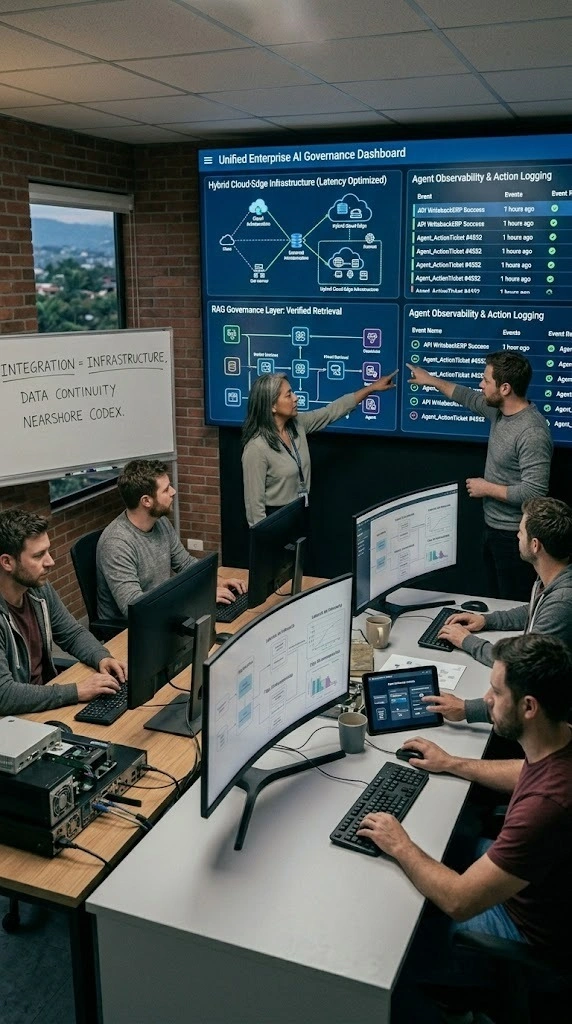
Patterns like RAG often sit at the center of that effort because they bring internal context to models without retraining everything. In real enterprises, RAG is often the difference between an assistant that sounds good and one that operates accurately. But it also introduces a new surface area for risk: which sources are allowed, how knowledge is versioned, what counts as truth for each function, and how the system avoids mixing outdated policies with new rules. In production, governance is not a document. It is a system layer: permissions, logic validation, traceable retrieval, and decision logging.
Are you looking for developers?
Observability changes scale when agentic systems arrive. An agent does not just respond, it acts. It opens tickets, updates records, triggers approvals, queries sensitive data, and chains steps across systems. If something goes wrong, the cost is higher than a bad answer. It can mean a broken process, a compliance issue, or a decision that is difficult to unwind. Running agents safely requires clear telemetry, auditability, role based access control, action limits, and safe fallback paths when an external dependency fails or confidence is too low.
At the center of all of this is integration. Enterprise AI does not live in the interface. It lives in backend development, reliable APIs, data pipelines that clean and route information, and enterprise integrations that connect systems without risky shortcuts. Most pilots fail when they hit this layer because it requires disciplined work: mapping data, normalizing events, managing identity, designing automation workflows, and keeping them stable under load. When that foundation is in place, AI stops being a feature and becomes infrastructure.
The most common constraint is talent. Not because companies lack capable people in general, but because it is hard to hire quickly for roles that combine integration, data, architecture, and operations. Meanwhile internal teams are often busy keeping existing systems running. That is where nearshore and staff augmentation become practical execution tools that do not stall operations. The point is not adding hands. The point is adding integrated capacity: people who work in the same backlog, use the same repos, follow the same standards, and deliver at the pace the business requires.
Are you looking for developers?

Square Codex fits naturally into that phase, when the challenge stops being conceptual and becomes operational. Square Codex is a Costa Rica based outsourcing company that provides nearshore software development teams for North American companies, with strength in backend work, APIs, system integration, and data flows. In modern AI infrastructure projects, the contribution is often the work that unlocks production: connecting existing platforms, structuring pipelines, strengthening observability, and building governance layers that make both model decisions and agent actions auditable.
There is also a less visible, but decisive, value: continuity. AI adoption is not a single launch. It is a cycle of changing data, new rules, and incremental improvements. Square Codex integrates with internal teams to sustain that execution so companies can scale capabilities while keeping control and reducing friction across systems.
The takeaway is straightforward. Enterprise AI infrastructure is not defined by the most impressive model, but by the discipline to integrate data, build governance, design hybrid architecture, and operate agents with traceability. Companies that treat execution as the main product will move faster with fewer surprises. The rest will keep collecting pilots that never become production.