

Samsung and AMD Signal a Shift Toward Supply Chain Control
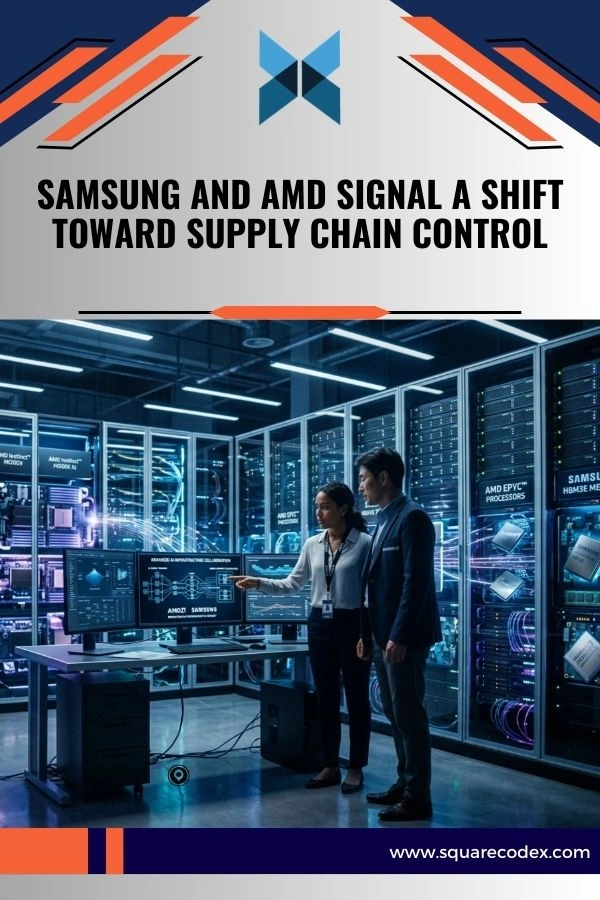
The artificial intelligence industry is going through an interesting moment. For years, attention focused almost entirely on bigger models and new capabilities. Now the conversation is shifting to something far more tangible: the infrastructure that makes those capabilities possible. Chips, memory, power consumption, data centers, and above all, the real ability to scale. In that context, the recent agreement between Samsung Electronics and AMD makes sense. It centers on new high performance memory solutions and a broader collaboration that could even extend into manufacturing processes.
There is a clear need driving this move. AMD is preparing its next generation of AI accelerators and server processors, which means securing critical components ahead of time. Samsung, for its part, wants to strengthen its position as a key memory supplier in a market where a single constraint can delay entire roadmaps. The agreement includes work around HBM4 memory for future AMD platforms, along with optimized DDR5 solutions for upcoming processors. Beyond the technical details, the goal is straightforward: ensure supply, reduce uncertainty, and lower supply chain risk.
Are you looking for developers?
In recent years, memory has become central to AI system performance. The spotlight used to be on the GPU, but in many real world deployments the true bottleneck is data movement. The speed at which information flows between memory and compute can decide whether a system runs efficiently or leaves performance on the table. Technologies like HBM are designed to ease that constraint, helping systems run with higher throughput and lower latency.
In this landscape, Samsung is not just another supplier. The company holds a major position in the global memory market, spanning DRAM and NAND, and it has been investing heavily in solutions tuned for AI workloads. On top of that, Samsung’s semiconductor manufacturing capabilities let it participate across more of the value chain. That combination explains why its collaboration with AMD goes beyond a standard commercial supply arrangement.
For AMD, partnerships like this are equally important. Its EPYC processors are already widely deployed in data centers, and its accelerator roadmap is pushing for a larger footprint in the AI ecosystem. In an environment where component availability can directly shape product plans, strategic suppliers help reduce uncertainty and improve planning precision.
Are you looking for developers?
Still, these kinds of deals do not matter only to hardware manufacturers. Companies across industries are bringing AI into operations, from real time analytics to process automation. That creates a different challenge: it is not enough to access advanced technology, you also need to integrate it correctly into existing systems.
This is where complexity rises quickly. Connecting AI models to enterprise platforms like management systems, sales tools, or internal databases requires thoughtful architecture. It is not just about deploying a model. It is about building the environment that allows it to run reliably, securely, and efficiently.
The idea of combining hardware, software, and data stops being theoretical and becomes a practical requirement. Even a powerful stack loses value if data does not flow cleanly, if processing introduces delays, or if there are no clear mechanisms to monitor what is happening. In regulated industries, additional requirements come into play, including security, access control, and traceable decision making.
In scenarios like these, technical talent becomes decisive. Companies need more than AI specialists. They need teams that can design, integrate, and maintain complex systems. This is where Square Codex fits naturally. As a Costa Rica based outsourcing company, Square Codex provides nearshore software development teams that work with North American companies to build solutions that match real operational needs.

Are you looking for developers?
Square Codex can support key areas such as backend development, API integrations, cloud architecture, and data pipelines. That approach helps organizations not only gain access to advanced infrastructure, but also turn it into real outcomes inside their day to day operations.
And the work does not stop after the first rollout. AI systems require ongoing tuning, monitoring, optimization, and adaptation as data volumes and product demands evolve. Here as well, Square Codex can add value by embedding into continuous operations, helping teams maintain stability, improve performance, and ensure solutions evolve alongside the business.
In the end, moves like the Samsung and AMD agreement reflect a change in how AI advantage is built. It is no longer only about better models. It is also about securing the infrastructure that supports them. The companies that combine strong technology choices with disciplined execution will be the ones that truly bring AI into stable, operational reality.