

Games and the Engineering Behind Smarter Characters
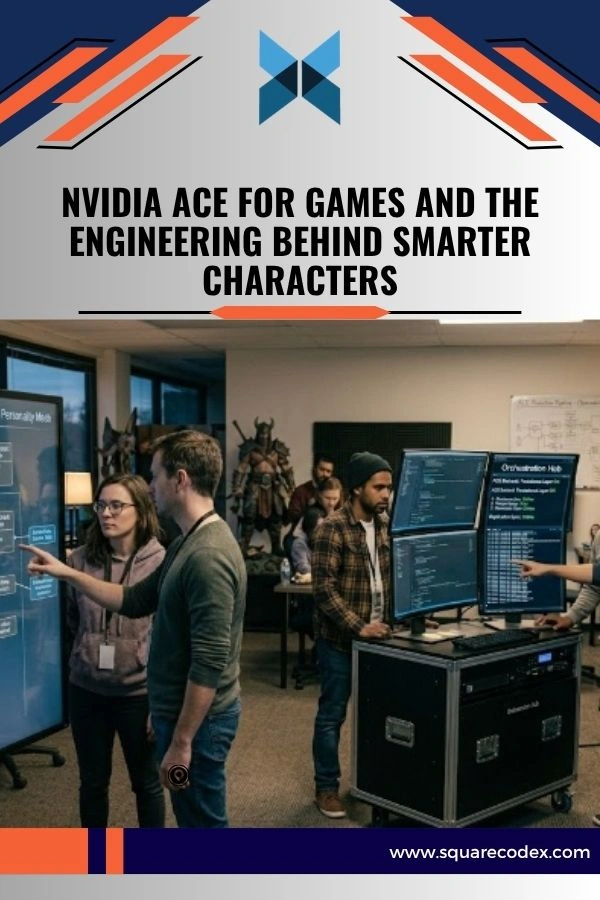
NVIDIA ACE for Games is a clear signal of where game development is heading: characters are no longer just state machines, scripted dialogue, and fixed behavior loops. They are moving toward interactive entities that can converse, react, and hold context. This is not a vague promise. It is a set of technical building blocks meant to help studios and middleware providers bring language, voice, and animation into gameplay while staying faithful to what games demand most: low latency, predictable performance, and consistency.
Looking at traditional NPCs makes the shift easier to understand. For years, an NPC’s “brain” was a mix of decision trees, scripts, and carefully authored lines triggered by quest flags. It worked because it was deterministic, cheap to run, and easier to test. The cost was rigidity. Anything outside the intended path broke immersion. With conversational NPCs, the center of gravity changes. It is not about selecting a line anymore. It is about sustaining a dialogue where the player asks open questions, changes direction, and expects responses that fit the world.
That experience cannot live in text alone. To feel playable, it needs speech to text that can handle real conditions, text to speech that stays consistent in tone and identity, and AI driven animation that aligns voice with gestures, gaze, and timing. If the NPC sounds natural but moves like a statue, the illusion collapses. This is why a suite like ACE matters as a concept. It brings together components studios often stitched together with fragile integrations that were hard to maintain across builds.
Are you looking for developers?

The real challenge shows up when you move from a demo to a full game. Putting AI inside gameplay is not adding a chat window. It is introducing a new system into the core interaction loop. That demands real time systems built around millisecond budgets, bursts of load, imperfect audio input, and players who will push every boundary. Latency is not a footnote. If an NPC takes too long to respond, the scene cools off and the moment becomes waiting. That is why the cloud and local inference question is operational, not philosophical. Local inference reduces round trips but competes with rendering, physics, and networking. Cloud inference adds capacity and faster iteration, but forces fallback design, disconnect handling, and cost controls per session.
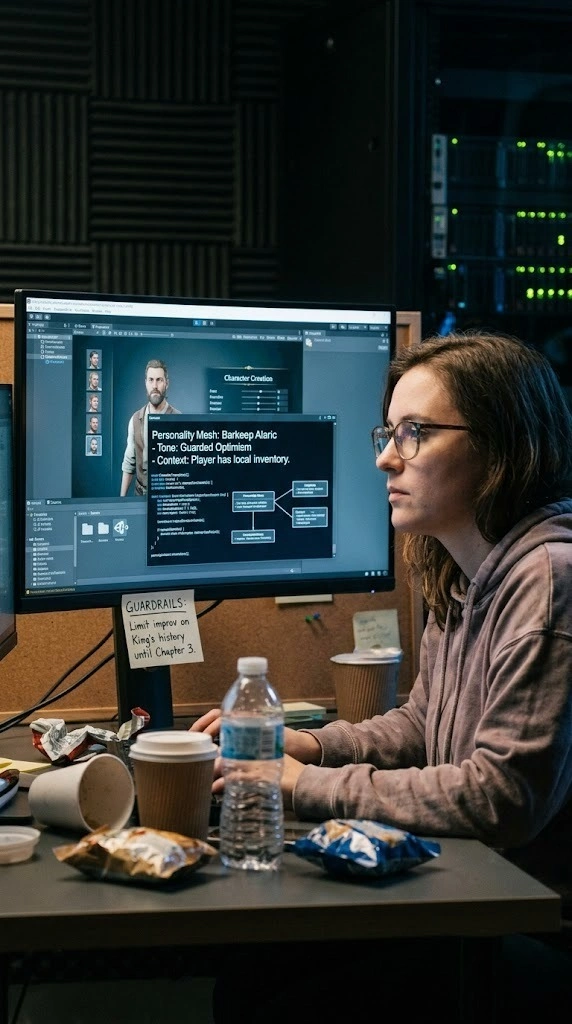
This shift also changes how studios work. Instead of authoring every line, teams design guardrails, personality, tone, knowledge boundaries, and safety rules. It starts to look like product design and tooling as much as narrative. Context control becomes critical because an NPC cannot freely improvise without breaking world logic or revealing information the player should not have yet. In multiplayer, the complexity increases again. Conversations cannot alter world state in ways that desync clients. Studios have to decide what is authoritative, what replicates, what is simulated, and what must be rejected to preserve integrity.
This is where multiplayer systems and scalable architecture come into play. A conversational NPC does not exist in isolation. It needs backend development for persistence, history, reputation, progression, quest flags, and player decisions. It needs APIs to query inventory, faction status, world events, economy rules, and content restrictions. It needs integration workflows that connect these calls to the engine without creating brittle coupling. When this foundation is right, the NPC does not only sound smart. It behaves with believable consequences. When it is wrong, the NPC becomes a text generator detached from the game.
Are you looking for developers?
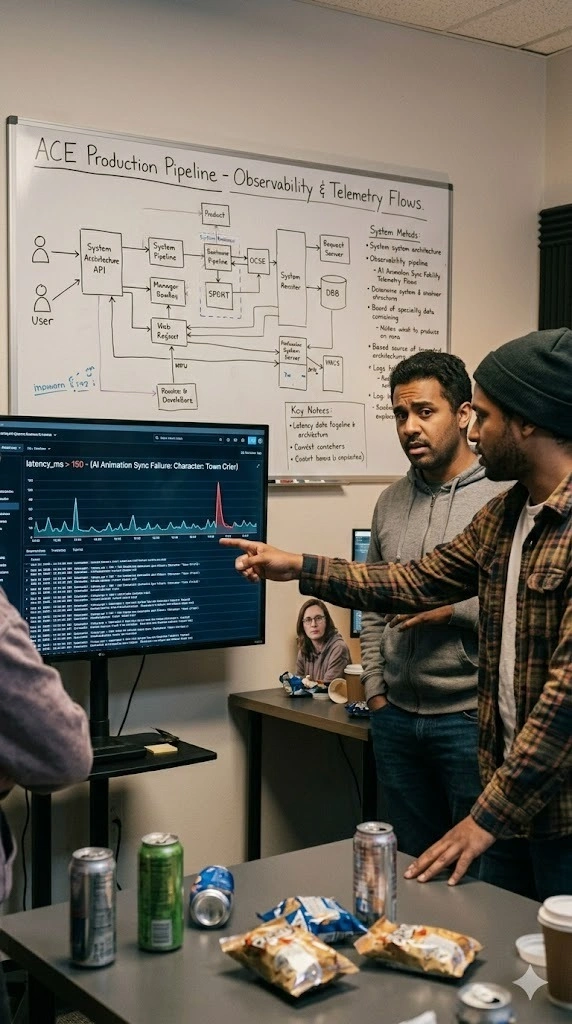
Production is the other hard reality. Gaming pipelines are already complex without AI: build systems, version control, asset validation, performance budgets, automated QA, and telemetry. Adding models and conversational logic introduces more tooling for game development, more test surfaces, more observability, and more discipline to keep delivery predictable. A character that behaves well today can drift tomorrow when content changes, prompts evolve, models update, or moderation rules shift. In production environments, what matters is consistency, not surprise.
This is where the talent gap becomes obvious. Shipping these features requires people who understand engines and backend, data engineers who can handle telemetry flows, architects who can connect conversation logic to real systems, and infrastructure specialists who can operate low latency services with controlled cost. Hiring that mix quickly is hard, and pausing development to rebuild teams is often more expensive than the original problem. That is why staff augmentation keeps showing up as an execution tool rather than a shortcut.
A well designed nearshore model can help studios keep momentum without blowing up production plans. The advantage is not just adding specialists. It is daily collaboration, fast iteration, and technical continuity. Square Codex, a Costa Rica based outsourcing company, supports North American teams with nearshore engineers who integrate directly with internal studios and squads. In gaming projects, the work often centers on backend, APIs, integration, and pipelines, which is exactly where AI stops being a demo and becomes an operational system.
Are you looking for developers?
Square Codex also fits when the challenge is maintaining production environments as services evolve. Conversational NPCs require logging, latency metrics, error handling, safe degradation paths, and repeatable tests so the game does not break every time a component changes. When internal teams are focused on content, art, and gameplay, external specialists can push the integration layer forward so the technology does not become a bottleneck. The goal is for AI to feel invisible: it works, it does not get in the way, and it can improve without drama.
As suites like NVIDIA ACE for Games mature, the studios that win will not simply be the first to “try AI.” They will be the ones that integrate it with discipline into their stack and pipeline. Square Codex can contribute to that transition through staff augmentation, embedding with internal teams to accelerate technical execution without slowing the roadmap. In gaming, the difference is rarely the idea. It is getting to production with stability, keeping quality under load, and learning from telemetry without breaking the player experience.