
How to Max Out ROI at AWS re:Invent 2025 in Las Vegas
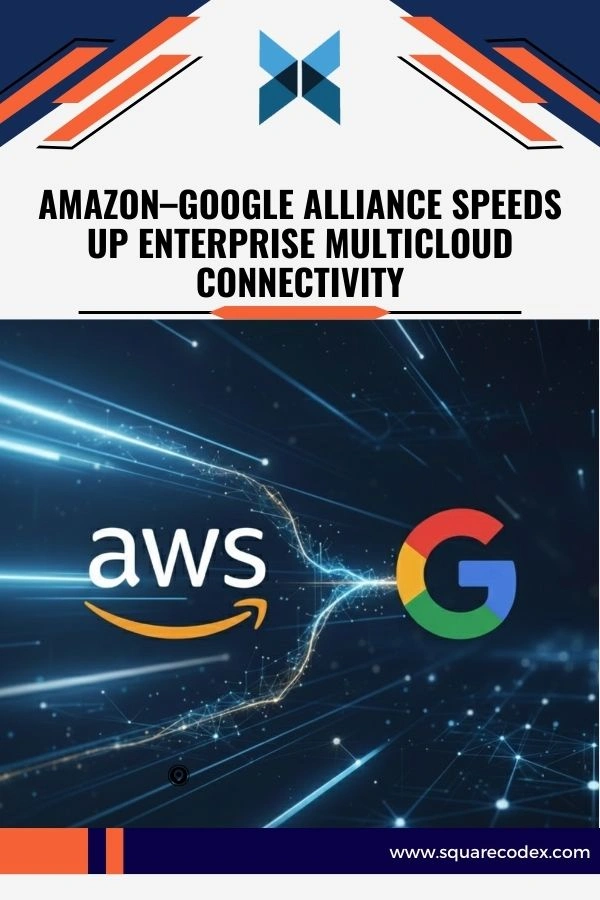
Amazon and Google have surprised the tech sector with an unusual move that speaks to the moment the industry is living through. The two companies launched a joint multicloud connectivity service that links workloads running on AWS with others hosted in Google Cloud in a matter of minutes. The solution combines Amazon’s Multicloud Interconnect with Google’s Cross Cloud Interconnect to provide private, high-throughput links that are ready to operate without the long implementation cycles that usually weigh down these projects. The aim is straightforward and very real for enterprise teams: cut weeks of engineering, remove avoidable complexity, and speed up data exchange between two of the most widely used platforms in business.
Context helps explain the scale of the announcement. Resilience no longer means staying within multiple availability zones of a single provider. It now requires running distributed workloads that can move across different clouds to guarantee continuity, efficiency, and responsiveness. Companies that train AI models, mirror data in hybrid architectures, or synchronize data lakes for near real time analytics know the cost of latency, bottlenecks, and route variability. A preconfigured private link that reduces setup to a few minutes is not a minor technical upgrade. It enables faster proof of concepts, shortens migration windows, and builds confidence in continuity plans that must hold up under pressure.
Are you looking for developers?

The gesture of cooperation is significant in a fiercely competitive market. A jointly built service does not erase the rivalry between the two giants, but it does acknowledge that enterprise needs cross commercial boundaries. Network interoperability stops depending on improvised workarounds and becomes a product with clear accountability on both sides. For technology leaders this means less friction, clearer incident handling, and a toolkit that behaves coherently at both ends of the link.
The announcement lands after a difficult year for reliability. Recent cloud outages reminded everyone that concentrating all operations with a single provider carries risk. The discussion that followed brought back the need for alternate routes, cross-cloud failover, and recovery strategies that are not trapped in the same affected ecosystem. A pre-integrated multicloud offer fits naturally into the continuity plans that boards and regulators now expect.
That does not mean the complexity disappears. Multicloud connectivity still brings challenges that go beyond a press release. Egress costs remain, data must be governed under different regulatory frameworks, security policies need alignment, and full observability is required across infrastructures that were designed with different philosophies. Orchestrating identity, protecting information in transit, segmenting networks, and gathering consistent telemetry is demanding work that calls for discipline and well-reasoned technical choices. The value is there, but organizations must define which data moves, how often, under what guarantees, and for what concrete purpose.
Are you looking for developers?
Cooperation between Amazon and Google puts pressure on other providers that have promoted private connectivity of their own. The reality is that the landscape will be defined less by choosing one cloud over another and more by the ability to operate across several and combine strengths as needs change. As models that require vast amounts of compute become common, the network turns into a strategic component. Latency stops being a purely technical metric and becomes a factor that touches business outcomes directly.
For many organizations this resets priorities. Teams that have tried to replicate vector indexes across platforms, distribute data pipelines, or balance inference across regions know that the line between an experiment and a dependable system is drawn by the network. A private link with clear guarantees and stable availability reduces uncertainty and unlocks active topologies in multiple providers. It also enables smarter cost analyses, since you can decide where to train, where to serve, and where to store based on the prices and capacity available at each moment.

Are you looking for developers?

In Latin America these shifts are already reshaping the demand for specialized talent. It is not enough to be in the cloud. Teams now need to master infrastructure as code across providers, automate deployments with each platform’s quirks in mind, unify security baselines, and run observability without blind spots. At this point, having experienced engineers makes the difference. Square Codex, based in Costa Rica, has become a partner for companies that need to integrate platform and DevOps engineers who can design, deploy, and maintain private cross-cloud networks, harmonize identities, configure consistent encryption, and expose comparable metrics at both ends. The contribution is not cosmetic. It is what turns a link into a robust multicloud service that supports data and AI strategies with auditable processes and tested recovery mechanisms.
In that same spirit, Square Codex supplies nearshore teams that plug into a client’s squads to take multicloud from plan to production. Senior platform and DevOps engineers operate infrastructure as code with Terraform or CDK, establish reliable connectivity between AWS and Google Cloud, align identity controls, and implement observability with SLO-driven metrics. Working in overlapping time zones means progress is measured in sprints rather than in months. From a sprint-zero assessment through runbooks and game days, the focus is on reducing latency, managing costs, and strengthening security without slowing delivery.