
Google Brings Intrinsic Inhouse and Signals the Next Phase of Industrial Robotics
Intrinsic joining Google should not be read as a routine internal reshuffle. It is a strategic signal: AI-driven industrial robotics is moving from isolated experimentation to a platform-level bet. Intrinsic was built around a clear ambition, to make building and running robotic applications feel closer to modern software development and less like a one-off engineering project that burns months on integration. By moving closer to Google’s core, the team gains direct access to infrastructure, cloud capabilities, and advanced models that are reshaping what “physical AI” can actually do in the real world.
Industrial automation has made steady progress for years, but it has always been constrained by complexity. Every production line has its quirks, every robotic cell demands specific configurations, and the talent that can bridge vision, control systems, safety, and data is not easy to find. The result has been powerful automation that is slow to scale. Intrinsic is trying to shorten that path by providing a software layer that standardizes how tasks are defined, how sensors are connected, and how stable plant operations are maintained.
The vision behind this consolidation is straightforward. The next wave of AI value will not stay on screens or dashboards. It will show up in machines that can perceive, reason, and adapt in real time. Robots that do more than repeat preprogrammed moves, robots that interpret their environment, understand signals, and adjust behavior with far more flexibility than traditional systems.
Are you looking for developers?
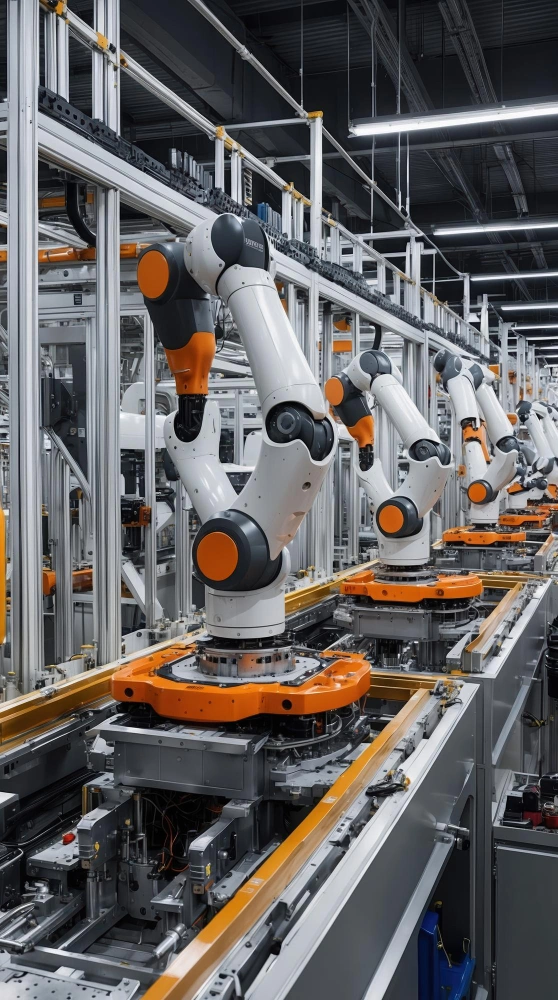
In that context, multimodal models matter. When a system can combine visual perception with contextual understanding and instruction-following, robots become less dependent on rigid rules for every possible scenario. That opens the door to more dynamic industrial settings where normal variation in materials, conditions, or process steps does not trigger a lengthy reprogramming cycle each time something shifts.
For manufacturers, the key question is not whether robots will get smarter. It is whether that intelligence becomes accessible. If a platform dramatically lowers the effort required to program, test, and deploy robotic workflows, the adoption threshold drops. Projects that once failed the ROI test can start to make sense. The pace of innovation changes too. Instead of long, manual integration cycles, organizations can move toward a more software-like loop: simulate, validate, deploy, and refine iteratively.
Greater accessibility, however, does not erase the hard problems. Industrial robotics still has to live in the world of legacy systems, critical processes, and environments that have little tolerance for failure. Integrating intelligent robots means connecting them to planning systems, production control, inventory, quality, and maintenance. Data has to move reliably between plant and cloud. Latency needs to be managed. Decision boundaries must be clear to prevent expensive disruptions.
That is why modernizing the underlying technology stack becomes decisive. A robot can look flawless in a controlled demo and then struggle in a real environment full of variability and operational constraints. Without a solid architecture, advanced models lose effectiveness quickly.
Are you looking for developers?
Cybersecurity adds another layer of complexity. The convergence of IT and operational technology expands the attack surface. Always-on connectivity, remote updates, APIs, telemetry, and model repositories demand network segmentation, strong identity management, and continuous monitoring. Security is no longer a bolt-on. It has to be designed in from the beginning.
As systems gain autonomy, governance becomes critical. Defining what a robot can decide on its own, under what confidence thresholds, and how actions are logged for audit is as much a management challenge as a technical one. Responsible autonomy means clear limits, plus reliable paths for human intervention when the system is uncertain or when risk is high.
In this environment, the difference between progress and frustration often comes down to whether innovation can be pushed into production without breaking what already works. That is where a specialized technical partner can add real value. Square Codex tends to be involved in projects where the goal is not just adopting advanced technology, but integrating it in a stable, scalable way. Its experience in system modernization, API integration, and enterprise automation helps connect new layers of intelligence to internal platforms without creating operational fractures.
In industrial robotics settings, Square Codex supports the design of robust data flows between plant and cloud, integrations with ERP and quality systems, and controls that ensure traceability and regulatory alignment. This turns automation into something auditable and sustainable, rather than a standalone experiment.
Are you looking for developers?

The real test usually shows up after the first pilot. Many initiatives work well at small scale but run into friction when expanded across multiple plants or production lines. Local differences appear, new regulatory requirements emerge, and operational variation exposes gaps that were not visible early on. In this phase, Square Codex contributes with observability practices, deployment automation, and applied governance, helping stabilize performance without letting costs spiral.
Intrinsic joining Google points to a broader shift toward platform-based industrial robotics. Value will not come from hardware alone, but from the ability to combine AI, software, and cloud into a coherent ecosystem. Competitive advantage will not simply be having the most advanced robot. It will be the ability to integrate robotics into real processes, measure impact, and optimize continuously.
For technology and operations leaders, the message is simple. AI-powered robotics will become more accessible, but not necessarily simpler. The winners will be the organizations that invest in solid architecture, disciplined integration, reliable data, and governance from day one. Innovation will not be sustained by a single successful deployment, but by the ability to replicate outcomes consistently.
The future of industrial automation will not belong only to those who build the most sophisticated models. It will belong to those who can bring them into the realities of the factory with rigor, security, and strategic clarity.