
Media’s AI Moment What It Takes to Deliver Personalization at Scale
Canal+’s decision to work with Google Cloud and OpenAI to bring artificial intelligence into video production and content recommendation is a clear signal of where the media industry is headed. The sector no longer operates only as a creative business. More and more, it is also a deeply technology-driven one. Streaming platforms and broadcasters are not competing solely on who has the biggest catalog or the most attractive exclusive rights. The real competition now is about how quickly a company can turn an idea into finished content, how effectively it can connect that content with the right audience, and how efficient its infrastructure is at handling massive data flows day after day.
In that context, AI is starting to act as the connective layer across the entire value chain. This is not an abstract promise about how AI might reshape the future. It shows up in concrete improvements that change daily operations: making editing rooms more efficient, producing more accurate metadata, improving how viewers discover content, and helping teams understand faster what is actually resonating with audiences. Initiatives like Canal+’s suggest that the competitive advantage in media will likely come from well-integrated infrastructure and disciplined execution, not from a single model or a flashy demo.
One of the highest-leverage challenges in streaming remains content discovery. Most services already use recommendation systems, but the next generation is moving beyond basic viewing patterns. Instead of only suggesting “more like this,” systems are beginning to interpret the viewer’s context. A person might be looking for something short to watch quickly, something comforting to end the day, an intense story, or something family-friendly.
AI systems can evaluate many signals at once, including viewing history, time of day, device type, session length, and even how a user navigates within the platform. The outcome is not just a different list of recommended titles. It is a deeper understanding of intent.

Are you looking for developers?
That level of personalization changes how a platform presents its catalog. Search becomes more conversational and less dependent on exact keywords. Recommendations stop being static lists and become dynamic surfaces that adapt to the user’s situation. Even the same title can be packaged differently depending on who is watching, using different artwork, descriptions, or trailers.
When it works, this approach helps reduce one of streaming’s most common problems: scroll fatigue, the moment when people spend too long searching and end up leaving. But if data and models are not managed carefully, the experience can turn into noise instead of relevance. That is why data quality and strong monitoring practices matter so much.
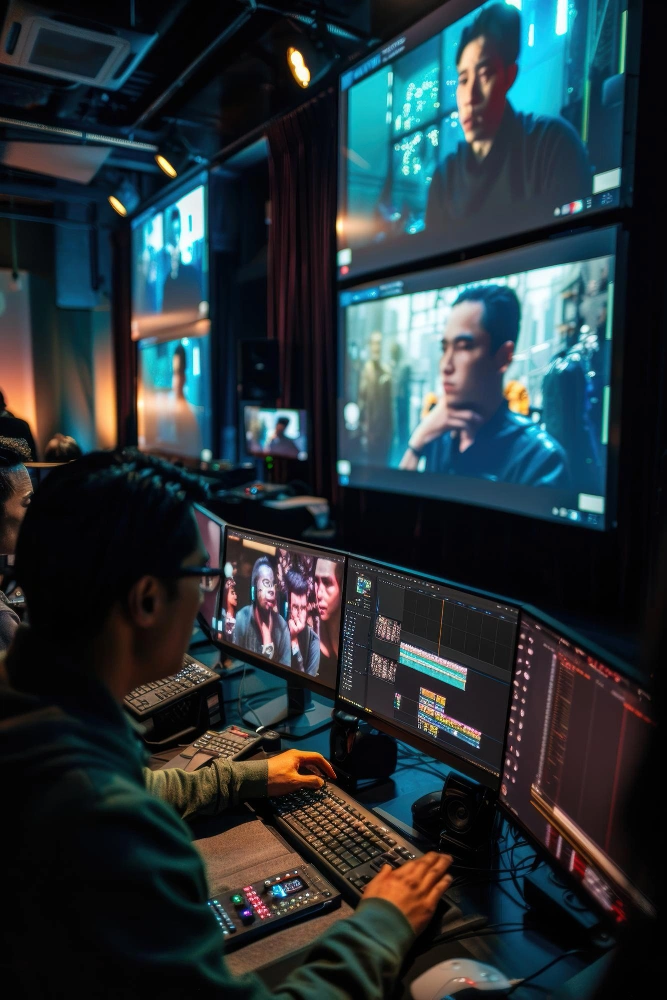
The other major front is production, where AI is beginning to deliver real operational impact. Creative teams face constant pressure to produce more content, generate multiple versions for different markets, and deliver promotional assets for different platforms. AI can speed up many of the tasks that usually consume the most time in production workflows.
That includes automatic transcription, scene detection, organizing shots, classifying visual material, and checking technical or regulatory requirements. These tools can also help editors quickly find specific moments inside large archives or generate timecoded summaries that make editing decisions faster.
In this environment, cloud platforms play a central role. Modern production workflows often involve distributed teams, external vendors, and multiple approval stages. AI-driven systems require compute, storage, and orchestration tools that can support these workflows reliably.
Are you looking for developers?
Putting this into practice means building complex pipelines. Video has to be ingested, processed to extract relevant signals, stored in a structured way, indexed for fast search, and integrated with review and publishing tools. The whole flow needs to be observable and auditable, especially when there are rights restrictions, regional regulations, or brand safety standards.
Data management becomes strategic as well. Metadata has always been essential for organizing content catalogs, but AI raises the bar for consistency and quality. Recommendations depend on accurate descriptors, production depends on reliable indexing, and rights management demands clear structures around ownership and usage. AI can generate metadata at scale, but it can also amplify problems if the underlying data structures are messy. That is why many media companies are building more unified data layers, with stronger governance and better version control.
The real potential appears when these layers connect. If production data feeds discovery systems, platforms can surface content more intelligently. And if viewing data flows back to production teams, they can learn what formats and approaches work best with audiences.
Still, building this kind of ecosystem is not simple. Integrating AI inside a media platform means coordinating multiple systems at once: content platforms, data infrastructure, analytics tools, recommendation engines, and user-facing applications.
That is where specialized technology partners become relevant. Companies like Square Codex help organizations turn AI initiatives into real operational systems. Square Codex, as a Costa Rican outsourcing company, provides nearshore development teams that work with North American companies to build software, integrate platforms, and design scalable architectures capable of supporting data-driven and automation-heavy systems.

Are you looking for developers?

In media-focused projects, the engineering work may include building data pipelines for audiovisual processing, creating APIs that connect recommendation systems to streaming applications, or modernizing backend infrastructure so new capabilities can be added without disrupting existing operations.
Square Codex also adds value in ongoing operations. AI systems are not “set and forget.” They require continuous improvement: refining recommendation quality, optimizing model performance, and ensuring the platform stays stable even during high-traffic periods.
Canal+’s move suggests the media industry is entering a phase where AI is no longer an add-on, but an integrated layer inside both production and distribution. In this new environment, the organizations that can combine creativity with strong technology foundations will be better positioned to compete in a market increasingly shaped by data and personalization.