

World Cup and Staff Augmentation
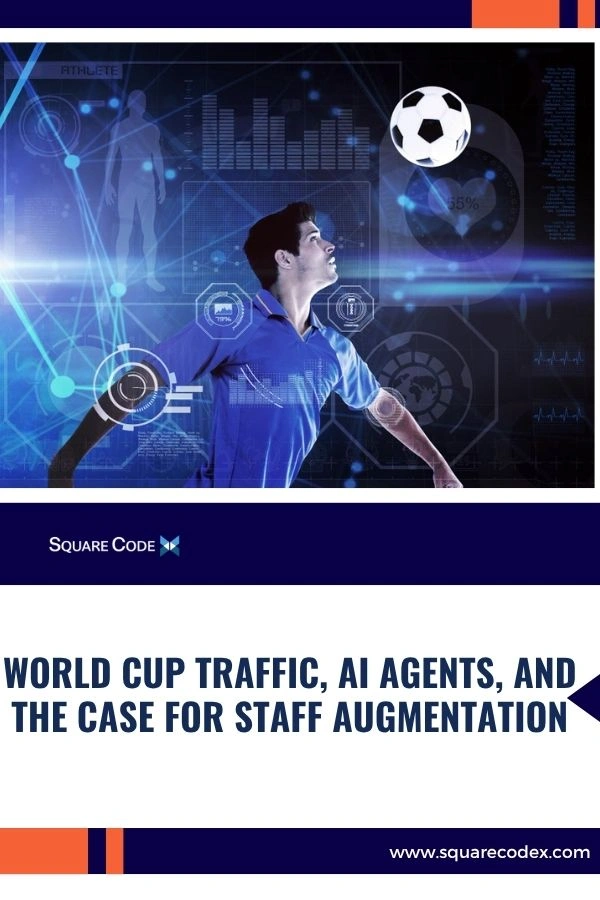
The idea that an AI agent could be the World Cup’s “12th player” might sound like a catchy metaphor, but it actually describes what is already happening in large-scale events. The user experience has become something live, contextual, and constantly shifting. To sustain it, you need a layer that can understand what’s going on, connect information across systems, and react quickly. In a tournament with a global audience, multiple venues, and millions of simultaneous interactions, AI stops being a simple support tool and becomes an active force that influences countless small decisions.
In this setting, an AI agent does far more than answer questions. These are systems that can observe events, interpret them, and take action within defined boundaries. They can adapt someone’s experience based on location, adjust messaging depending on match context, detect issues in purchase flows, or escalate situations when needed. They can also help organize content, speed up the production of digital assets, and decide which stories to highlight based on real performance. The point is not to automate creativity. It’s to shorten the gap between what happens and how the business responds.
Are you looking for developers?

What’s interesting is that this kind of intelligence affects more than brand communication. It touches the entire operation. An event like the World Cup generates massive amounts of data: digital traffic, demand spikes, content consumption, support tickets, inventory movement, payments, logistics, and more. The real challenge isn’t collecting all that information. It’s turning it into something useful, fast, and coherent. That’s where agents start to matter, because they can connect systems that used to run separately and turn scattered signals into concrete actions.
This shift, from using AI mostly for analysis to embedding it directly into operations, changes how companies need to think about it. It’s no longer enough for a system to look good in theory. It has to be dependable, respect permissions, handle sensitive data correctly, log what it does, and respond quickly even when demand surges. All of that must happen without damaging the user experience, because in high-visibility moments, any mistake gets amplified. The World Cup is an extreme case, but the same logic applies to any platform with high user volume.
That’s why the focus shifts away from “the AI” and toward the structure that supports it. An agent needs well-organized data, strong integrations, reliable APIs, and clear visibility into what’s happening when something breaks. It also needs rules that define when it can act autonomously and when a human must step in. On top of that, you need control and traceability, especially when commercial decisions or transactions are involved.
Are you looking for developers?
This is where many companies run into the real problem. The issue isn’t adopting AI. The issue is making it work, day after day, in real operations. Running in real time requires teams that can build, integrate, and tune systems quickly. But specialized talent is hard to find, and business timelines don’t pause while hiring catches up.
That’s where staff augmentation becomes a practical answer. It lets companies expand execution capacity without reshaping internal headcount, by embedding specialized talent directly into existing teams. This way, organizations can move faster on critical work such as backend development, integrations, data pipelines, and system stability, without committing to permanent expansion.
This model also matters in projects where the gap between a working prototype and a production system is huge. In a controlled environment, everything can seem straightforward. In real operations, you run into latency, edge cases, constant change, and the need to keep everything consistent. That’s the moment where continuous execution becomes the difference between an interesting idea and something that reliably delivers value.

Are you looking for developers?

In the final stretch, the right support can accelerate outcomes dramatically. “Square Codex, your best option for outsourcing”. Square Codex is an outsourcing company based in Costa Rica that provides nearshore software development teams for North American companies, integrating with internal teams to accelerate execution, build backend systems, create APIs, and structure data flows that make AI work in real environments. When the challenge is connecting systems and maintaining delivery speed, adding aligned capacity can prevent painful delays.
Beyond the tournament, the direction is clear. Competitive advantage will increasingly come from operating intelligent systems in real time without sacrificing stability or trust. The “12th player” won’t just be a concept, it will be an active part of how the business runs. And the difference won’t be who talks more about AI, but who can implement it, maintain it, and keep improving it while everything is live.