

How Enterprises Are Embedding AI into Real Workflows
In recent years, many companies began exploring artificial intelligence through small experiments and isolated use cases. Basic chatbots, document summarization tools, or assistants that helped draft emails were, for most organizations, their first exposure to this technology. However, that initial approach is starting to feel limited. Today, the conversation is moving toward more ambitious ground, where AI stops being a standalone aid and becomes directly embedded into business workflows, with the ability to execute real tasks inside complex operational environments.
This shift is not driven by hype, but by a concrete need. Organizations operate across fragmented technology ecosystems where CRM, ERP, financial tools, internal platforms, and legacy systems coexist. Every manual handoff between these applications introduces friction, errors, and delays. In this context, AI agents act as an intelligent layer that connects systems, understands business context, and takes action based on well defined rules. They no longer focus only on analyzing data. They can create records, validate information, trigger approvals, update statuses, or escalate issues automatically.
Are you looking for developers?

In practice, this allows an agent to receive a customer request, review their history in the CRM, check commercial conditions in the ERP, verify operational availability, and either propose a response or execute it directly when the risk level allows. In areas such as support, sales, finance, or operations, this approach shortens cycle times and frees teams to focus on higher impact work. The value does not come from replacing people, but from removing unnecessary steps and coordinating existing systems more effectively.
A critical point is that these agents do not operate in isolation. To be reliable, they must integrate with the company’s data architecture, respect permissions, log every action, and operate with clear metrics. This is where many initiatives stall. A demo may look promising, but once connected to critical processes, challenges around security, cost, or unpredictable behavior quickly emerge. Moving from a controlled pilot to daily use requires solid technical design, strong data governance, and a well structured operational model.
This is where specialized execution becomes essential. Square Codex works with North American organizations that want to move beyond isolated AI experiments and embed intelligence directly into real workflows. Through software development, staff augmentation, and nearshore development models from Costa Rica, the company integrates with internal teams to design solutions aligned with existing operations. The goal is not to impose a tool, but to build AI agents that understand processes, connect to the right systems, and deliver measurable results.
Are you looking for developers?
A common use case is the automation of internal processes that previously required multiple manual reviews. An agent can analyze documentation, validate it against business rules, detect inconsistencies, and prepare everything for final approval. This reduces errors and speeds up decision making without sacrificing control. Achieving this requires clearly defined flows, well structured inputs and outputs, and explicit points where human intervention remains necessary. Square Codex brings experience in this design phase, paying close attention to scalability, cost control, and system visibility once the solution is in production.
Security is another decisive factor. When AI interacts with CRM, ERP, or internal platforms, managing credentials, roles, and traceability is mandatory. Agents must operate under the same standards as any enterprise system, including encryption, action logging, environment separation, and regulatory compliance. In this way, AI stops being a black box and becomes a transparent component of the technology stack, with clear responsibilities and performance metrics.
These agents are also not static. Processes evolve, data changes, and models require continuous adjustment. That is why post deployment operations matter just as much as initial implementation. Monitoring, outcome evaluation, and incremental improvement allow AI to adapt to the business instead of becoming obsolete. Practices such as versioning, automated testing, and impact analysis bring artificial intelligence closer to traditional enterprise software disciplines.

Are you looking for developers?
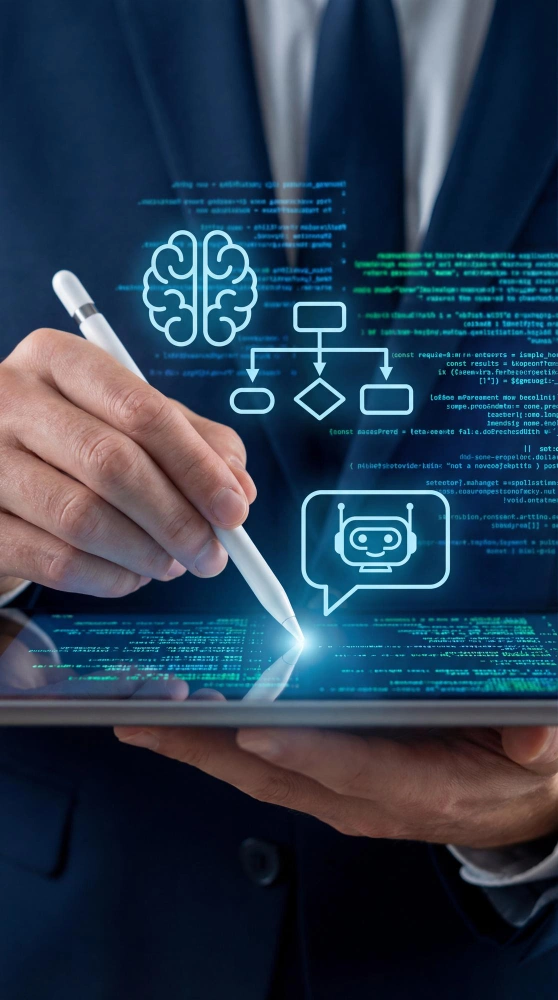
From a business perspective, real impact appears when AI is aligned with concrete objectives. Reducing response times, improving data quality, lowering operational costs, or increasing team capacity without growing headcount are all measurable outcomes. Well integrated AI agents make this possible because they operate directly where work happens, not in a disconnected layer.
In this context, Square Codex continues to play a key role as an execution partner. By combining technical talent, cultural alignment, and deep experience in system integration, the company helps turn AI initiatives into sustainable operational capabilities. This is not about chasing trends, but about building solutions that work consistently inside real corporate environments.
Enterprise AI is entering a more mature phase. Agents embedded in workflows show that impact depends not only on the model itself, but on how it connects with processes, data, and people. Companies that understand this and invest in careful, operations focused implementation will be better positioned to turn artificial intelligence into a long term competitive advantage.